
Tepte.com


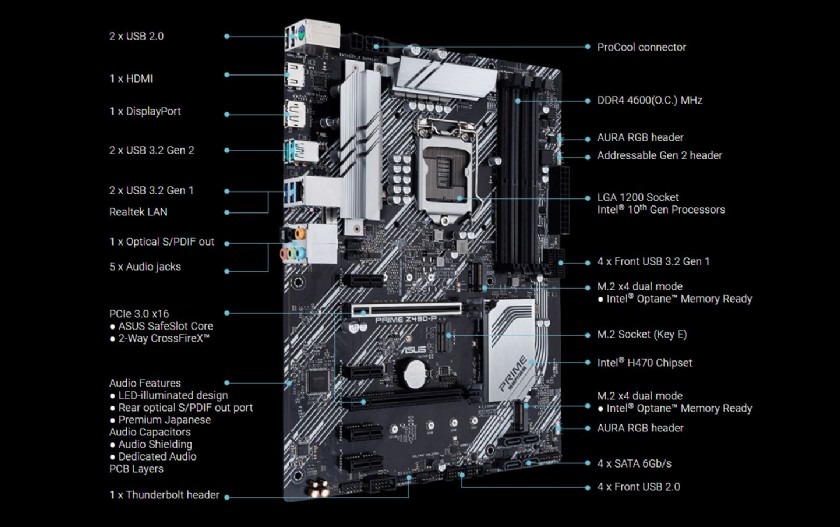
A motherboard (alternatively known as the mainboard, main circuit board, system board, baseboard, planar board or logic board, or colloquially, a mobo) is the main printed circuit board (PCB) found in general purpose computers and other expandable systems. It holds, and allows communication between, many of the crucial electronic components of a system, such as the central processing unit (CPU) and memory, and provides connectors for other peripherals. Unlike a backplane, a motherboard usually contains significant sub-systems such as the central processor, the chipset's input/output and memory controllers, interface connectors, and other components integrated for general purpose use and applications.
Motherboard specifically refers to a PCB with expansion capability and, as the name suggests, this board is often referred to as the "mother" of all components attached to it, which often include peripherals, interface cards, and daughtercards: sound cards, video cards, network cards, hard drives, or other forms of persistent storage; TV tuner cards, cards providing extra USB or FireWire slots and a variety of other custom components.
A motherboard provides the electrical connections by which the other components of the system communicate. Unlike a backplane, it also contains the central processing unit and hosts other subsystems and devices.
A typical desktop computer has its microprocessor, main memory, and other essential components connected to the motherboard. Other components such as external storage, controllers for video display and sound, and peripheral devices may be attached to the motherboard as plug-in cards or via cables; in modern microcomputers it is increasingly common to integrate some of these peripherals into the motherboard itself.
An important component of a motherboard is the microprocessor's supporting chipset, which provides the supporting interfaces between the CPU and the various buses and external components. This chipset determines, to an extent, the features and capabilities of the motherboard.
Motherboards contain some non-volatile memory to initialize the system and load some startup software, usually an operating system, from some external peripheral device. Microcomputers such as the Apple II and IBM PC used ROM chips mounted in sockets on the motherboard. At power-up, the central processor would load its program counter with the address of the boot ROM and start executing instructions from the ROM. These instructions initialized and tested the system hardware displayed system information on the screen, performed RAM checks, and then loaded an initial program from a peripheral device. If none was available, then the computer would perform tasks from other memory stores or display an error message, depending on the model and design of the computer and the ROM version. For example, both the Apple II and the original IBM PC had Microsoft Cassette BASIC in ROM and would start that if no program could be loaded from disk.
A CPU socket (central processing unit) or slot is an electrical component that attaches to a Printed Circuit Board (PCB) and is designed to house a CPU (also called a microprocessor). It is a special type of integrated circuit socket designed for very high pin counts. A CPU socket provides many functions, including a physical structure to support the CPU, support for a heat sink, facilitating replacement (as well as reducing cost), and most importantly, forming an electrical interface both with the CPU and the PCB. CPU sockets on the motherboard can most often be found in most desktop and server computers (laptops typically use surface mount CPUs), particularly those based on the Intel x86 architecture. A CPU socket type and motherboard chipset must support the CPU series and speed.
 90 times.
tepte.com: Your Questions and Answers Resource with a Wealth of General Knowledge
Are you seeking a one-stop destination for comprehensive knowledge and answers to your burning questions? Look no further than tepte.com! Our platform is your go-to source for a wide range of information, all conveniently presented in an easily accessible question and answer format.
At tepte.com, we pride ourselves on being your reliable knowledge hub. Whether you're curious about technology, science, history, or any other subject under the sun, our extensive General Knowledge (GK) knowledge base has you covered. We've made it our mission to provide you with in-depth insights and facts on an array of topics. Read more
